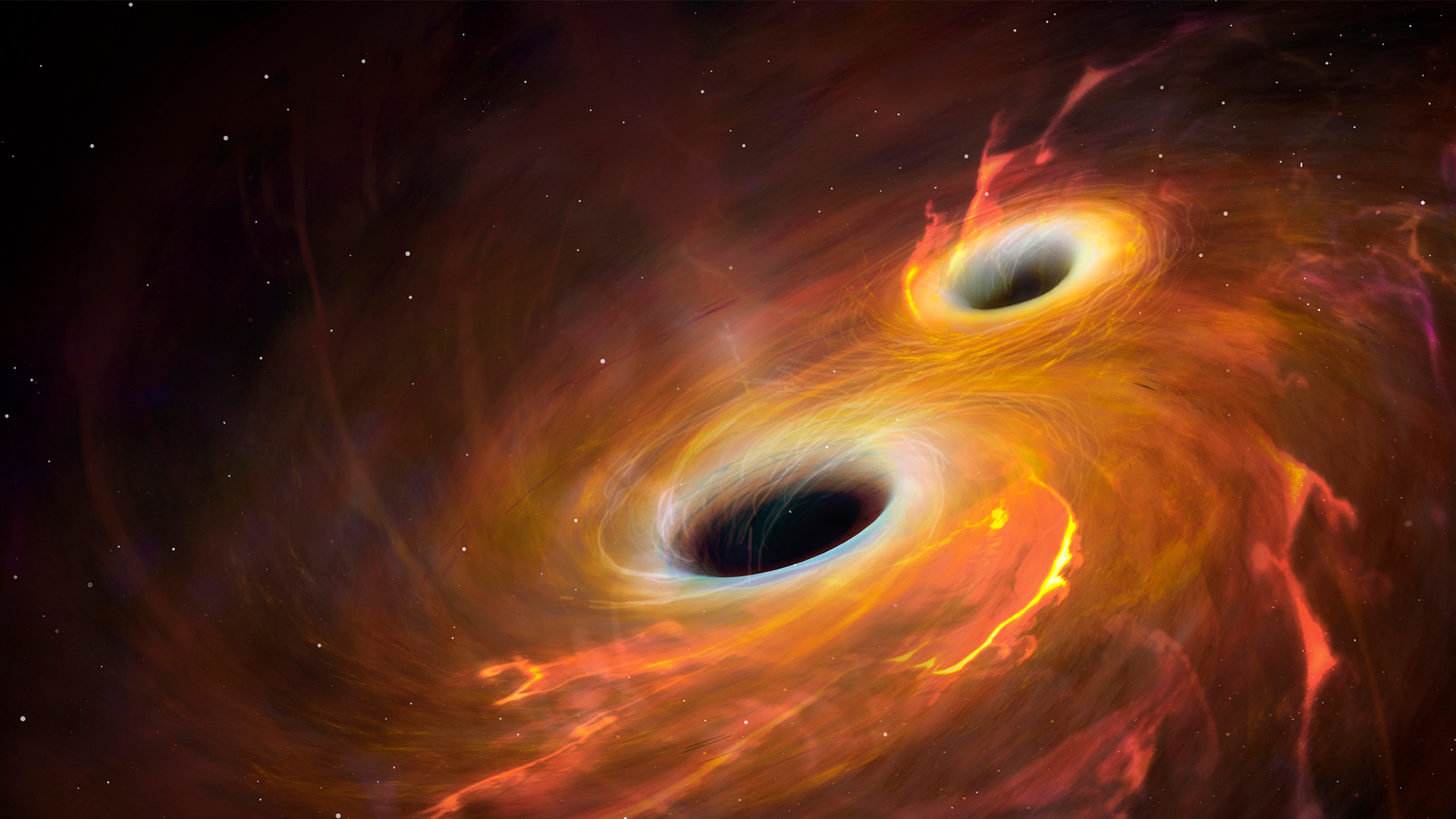
Stephen Hawking showed in the 1970s that black holes are not completely black. They slowly emit radiation and shrink over time, eventually disappearing. However, there was a problem with this explanation.
If a black hole evaporates completely, what happens to all the information about the matter it has absorbed? Quantum physics says that information cannot be destroyed, yet black holes seem to do exactly that. This contradiction is widely known as the “black hole information paradox”.
“The black hole controversy represents one of the most important challenges in modern theoretical physics, raising questions about the interaction between quantum mechanics and general relativity,” the authors of the study note.
Now, a new study offers a way out of this problem. It suggests that black holes do not disappear completely. Instead, they leave small, stable residues that store information—and surprisingly, the same theory can also explain how elementary particles get their mass.
A twisting universe and the force that stops the edge of a black hole
To solve this problem, the researchers went beyond the conventional picture of gravity. According to general relativity, spacetime can bend under the influence of gravity and force.
However, the theory used in this study, called the Einstein–Cartan theory, allows space-time to do more than just bend—it can also twist. This twisting, known as torsion, becomes important at very small scales and very high references.
The team tested this idea in a universe with seven dimensions, instead of the four we have. They used a special mathematical method called the G2-manifold with torsion, which provides a consistent way to describe how these extra dimensions work. Although this sounds absurd, the physical effect is surprisingly clear.
As matter collapses into a black hole and the density rises to the Planck scale, the collapse of space-time begins to produce a repulsive effect. This force pushes outward, fighting the internal gravity. “The presence of repulsive energy in the Planckian densities strongly stops the last phase of Hawking evaporation,” the authors of the study said.
Instead of collapsing indefinitely or completely evaporating with Hawking radiation, a black hole reaches a steady state. “This leads to the formation of a stable residue with a predicted mass of about 9 × 10⁻⁴¹ kg,” the authors of the study added.
This changes the fate of black holes completely. If they don’t disappear, the content they contain shouldn’t disappear either.
A 7-dimensional concept hidden in the remains of black holes
The next question is where the content resides. According to the study, it is embedded in the internal structure of the residue in what physicists call quasi-normal modes. These are the natural patterns of vibration of an object, similar to how a bell rings after being struck.
In this model, the vibration occurs in the torsion field within the residual geometry. Each vibrational pattern can carry quantum information, effectively turning the residue into a storage system.
The main idea here is that all the information that fell into the original black hole is captured and put into long-term oscillations. The size of this storage is also very large. For example, the remnants of a black hole with the mass of our Sun can store about 1.515 × 10⁷⁷ qubits of information.
This corresponds to the amount needed to store everything that could be lost during the evaporation, “to prevent the complete disappearance of the black hole, and thus to solve the problem without violating the principles of physics,” the authors of the study said.
These findings are eye-opening as they link black hole physics to particle physics. When the researchers reduced their seven-dimensional model to four dimensions – the universe we see – they found that the same torsion field naturally produces an energy of about 246 GeV.
This is an accurate measurement related to the Higgs field, which is responsible for giving mass to the elementary particles. Simply put, the same geometric feature that prevents black holes from disappearing also explains why particles have mass.
An idea beyond testing—for now, but not attainable
Another reason why more measurements are not taken into account is that the energy required to analyze them is far beyond the current technology.
For example, the study predicts that particles bound to these dimensions will have a mass of about 8.6 × 10¹⁵ GeV, which is millions of times higher than what the Large Hadron Collider can achieve. This makes it unavailable directly at the moment.
However, that theory does not stand up to the test. The gravitational effects of the remnants of the tiny holes that describe it can be seen in astronomical observations. Future work will focus on improving the model and searching for these signals.
For now, the study strongly suggests that black holes may not be the end of information after all. Instead, they can be nature’s most amazing storage devices, secretly storing the history of everything that has ever fallen into them.
The study was published in the journal General Relation to Gravity.
#Model #reveals #black #holes #give #birth #remnants #death