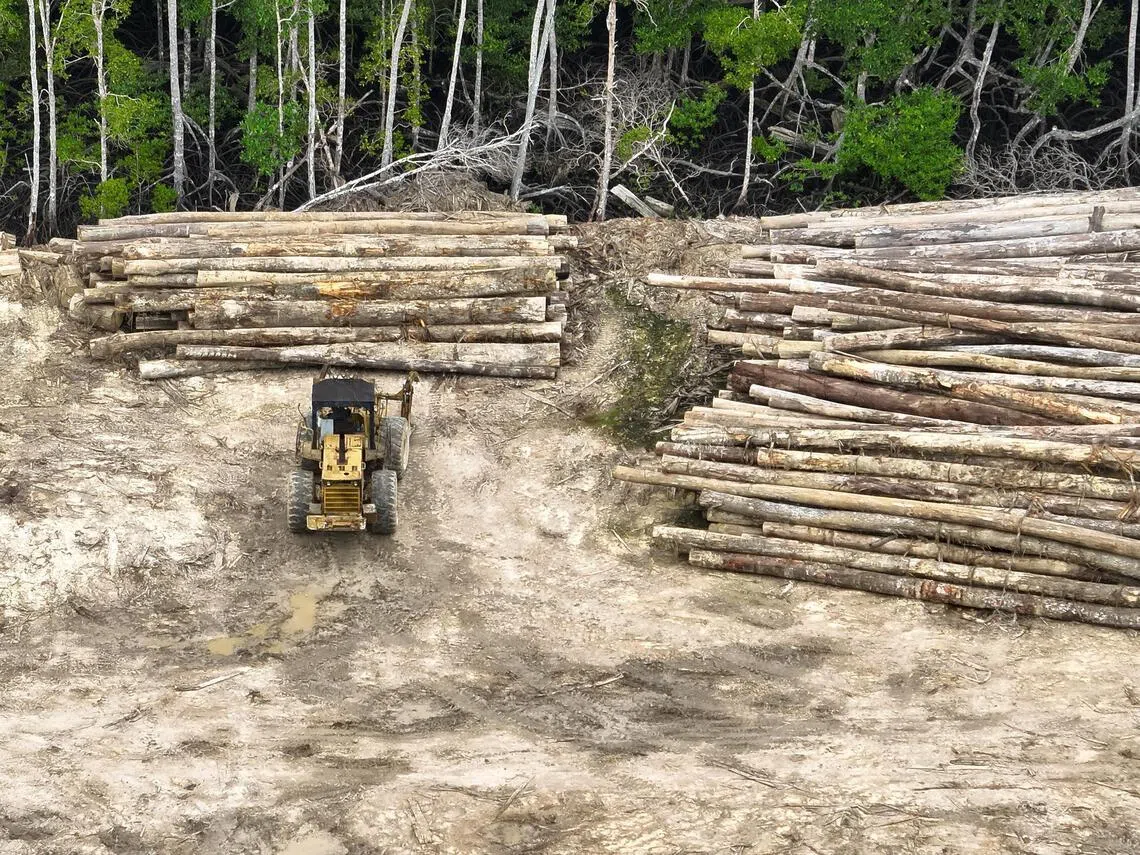
JAKARTA – Indonesia faces increased risk of forest fires in 2026, not only influenced by the predicted El Nino weather, but also with an increase in deforestation that has reached its highest level in almost 10 years, according to environmental activists in Jakarta.
Auriga Nusantara, a Jakarta-based think tank focused on forestry and environmental conservation, said. deforestation to increase by 66 percent by 2025, from 2024 levels.
Forest loss has been driven by a complex combination of food processing and bioenergy crops and palm and timber plantations, mining expansion and severe flooding in northern Sumatra due to Typhoon Senyar last year.
Releasing its annual assessment of deforestation on March 31, Auriga called on the government to pay more attention to 2026, stressing that a repeat of the devastating fires of 2015 in Sumatra and Kalimantan cannot be ruled out.
“What is alarming is that deforestation is often followed by fires,” said the chairman of Auriga. Timer Manurung, when answering questions from The Straits Times on March 31.
He added: “Naturally, fires do not burn easily in a healthy forest.
Indonesia’s 2015 fire season burned nearly 2.6 million hectares and caused a major environmental and public health crisis, with the Indonesian National Disaster Mitigation Agency (BNPB) reporting that more than 500,000 people suffered from severe respiratory illnesses. Deforestation and fires also release large amounts of greenhouse gases.
The World Bank said the disaster, which spread toxic fumes across Southeast Asia, caused economic losses estimated at 16.1 billion dollars.
Auriga said deforestation in Indonesia reached 433,751ha in 2025, compared to 261,574ha in 2024, and 257,385ha in 2023, based on analysis of satellite images and research on the most recently deforested areas.
It was the highest pace of deforestation since 2016, when more than a million hectares were bought, the think tank noted.
Of the 433,751 purchased, only 58 percent were legally harvested for other uses, including agriculture, Auriga said.
Perhaps to make matters worse, Indonesia is preparing for an unusually severe and long dry season in 2026, with forest and land fires already on the rise, even before the onset of El Nino, a weather pattern that causes less rain, longer droughts and higher temperatures in Southeast Asia.
Indonesian Institute of Meteorology, Climatology and Geophysics recently predicted a 50 to 60 percent chance of a weak to moderate El Nino continuing in the second half of 2026, warns that this could worsen drought conditions.
The National Center for Research and Innovation issued a more dire forecast on March 19, warning that a powerful “Godzilla El Nino” is set to hit the country, beginning in April.
Although it is still too early to say how bad the El Nino event will be, the outbreak of fires in Sumatra and Kalimantan is already increasing and its number has almost doubled in the first three months of 2026, compared to the same period in 2025, according to BNPB.
About a fifth of deforestation by 2025 was due to clearing land for food and bioenergy crops under a government program aimed at boosting self-sufficiency in food and energy.
The Prabowo administration is pushing hard to increase its national food and energy program and has allocated 20.6 million hectares of forest land to help boost rice, corn and sugar production as well as sugar palm. The government is promoting bioethanol and biodiesel as a way to curb fuel imports.
The program has alarmed conservationists who fear the deforestation of millions of hectares of forest – Auriga has managed 8.8 million hectares of natural forest out of a distribution of 20.6 million hectares.
Similar food center programs by previous administrations failed to increase crop production significantly, but caused widespread damage to the environment.
“Government programs for food supplies act as the main cause of deforestation,” said Mr. Timer, pointing out that in Central Kalimantan, for example, this program directs the loss of forests directly in areas that are not considered.
In Central Kalimantan, the government earmarked more than 770,000ha for rice and cassava cultivation, much of which adjoins environmentally sensitive and previously degraded areas.
In Merauke, in the province of South Papua, the government has supported a project covering about two million hectares, dedicated to sugarcane for the production of bioethanol and rice, drawing strong criticism from environmentalists.
“Merauke is another area controlled by peat. We are talking about an environment that keeps a lot of stored energy,” Mr Timer argued, stressing that turning peatlands into agricultural food areas destroys this important moisture, causing fire chances and serious health consequences for the local community.
“The government must be very careful to ensure that these areas maintain their natural moisture.”
Of the 433,751 hectares of afforestation in 2025, about 28,889ha of it was timberland.
Dr Ristianto Pribadi, a spokesman for the Forestry Department, told ST that Auriga’s data and assessments are very important, and emphasized that the service shares its goal of preserving Indonesia’s forests.
More than half of the deforestation in Indonesia by 2025 was illegal logging, including this area in Berau, East Kalimantan province.
PHOTO: COURTESY OF AURIGA NUSANTARA
But the department said it has a different figure for deforestation – 166,450ha for the period January-September 2025, with full-year figures yet to be released.
The different numbers may be due to differences in definitions, methods and statistical methods, rather than different facts on the ground, it said.
Regarding the increasing pressure on forests, Dr. Ristianto said the ministry will deal with it seriously: “The government maintains strict control through monitoring based on management, land maintenance and law enforcement against crime.”
Mr Timer, noting that the damage is worse when these fires occur in peatlands, he added: “Although the fires started by farmers and villagers are usually small in scale, those caused by commercial activities tend to be large.”
That’s because peat fires can burn for weeks and emit thick, toxic smoke that spreads everywhere. Small particles of smoke, or mist, enter the lungs and can cause breathing problems and worsen heart conditions.
And Uli Arta Siagian, coordinator of the national implementation campaign in the conservation group WALHI, they believed that deforestation increases the risk of forest fires. He He emphasized that the re-emergence of forest and land fires – such as peatland or grass fires – it shows the lack of progress in governance reform, as well as weak enforcement of the law against corporate criminals.
And Uli it also bemoans the limited emergency funding allocated to reduce forest fires by 2026 – including the expensive cloud seeding operation. The reduction budget is only three trillion (S$227 million), while the budget allocated to BNPB stands at only 491 billion rupiah.
In comparison, Indonesia’s national government spending is planned at 3,843 trillion rupiah for 2026, of which 335 trillion rupiah is earmarked for the free nutritious food program for children and pregnant women.
“We cannot rule out the possibility that the impact of this year’s forest fires could be repeated, like the severe fires of 2015,” said Ms Uli, emphasizing that Riau is also at the peak of forest and land fires in 2026.
Mr Eko Yunanda, the WALHI-based forestry campaigner, said the organisation’s survey revealed that more than a third of Riau’s hotspots between January and March were within the concessions of 10 palm and pulpwood plantation companies operating across the province.including the islands of Rupat, Bengkalis and Mendol.
This should raise alarm bells, him it said, and added: “The government should cancel the business licenses of the organizations that have had cases of fires many times when they allow it.”
#Deforestation #Nino #increase #Indonesias #haze #risk