For more than two decades, textbooks and science fairs have been telling the same story that the universe is not only expanding, but accelerating. Now a new wave of data is quietly shaking up that picture and giving new life to a mysterious ending called the Big Crunch, where everything in the universe finally collapses together.
New measurements of dark energy from massive maps of the galaxy and a bold analysis of old supernova data suggest that the mysterious force pushing space apart may be weakening over time. If that process is real and continues long enough, one day gravity may win the cosmic battle, slowing the expansion, stopping it, and eventually reversing it so the universe begins to contract. Scientists are happy, but they also warn that the case is far from closed.
What scientists say about dark energy and the Big Crunch
Dark energy is the name given to a very mysterious effect that causes distant galaxies to move away from each other rapidly over time. Instead of pulling things together like normal gravity, it acts like a gentle pressure within space itself, stretching the fabric of the universe. For many years, many cosmologists considered it to be a constant backward process that is not changing, leading to an infinite expansion that is increasing rapidly.
The Big Crunch is almost a mirror image of that story. At this point, the dark force is so weak that gravity starts to dominate again. The expansion starts slowly, then stops, then reverses, until every galaxy, star, and atom is pulled back into a very dense, hot atmosphere similar to the conditions immediately after the Big Bang.
Some models even think that a new Big Bang could follow, leading to a cyclical or “bouncing” universe.
New maps of the universe show that dark energy is changing
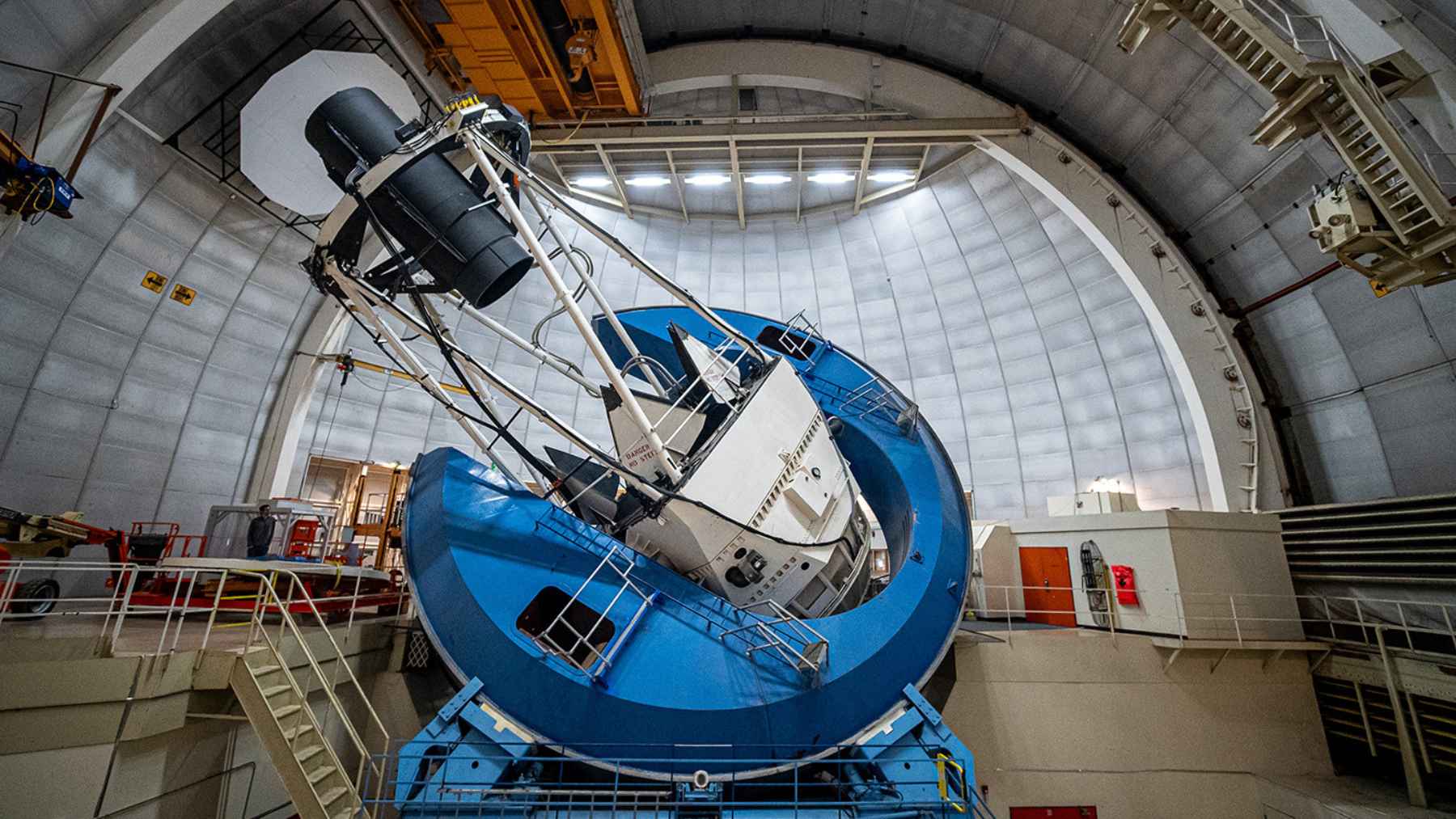
A key part of this game comes from the Dark Energy Spectroscopic Instrument, an international probe that has built the largest three-dimensional map of the universe ever made. Using light from about fifteen million galaxies and quasars spread across eleven billion years of the universe’s history, DESI tracks the pattern of how matter clumps together called baryon acoustic oscillations, which act as a kind of standard ruler for measuring expansion.
When the DESI data is combined with other observations, such as the dim light of the Big Bang and ancient supernova research, it points to a surprising possibility. Several groups now see evidence that dark energy was strong a few billion years ago and appears to be about ten percent weaker today, meaning that the universe is expanding but appears to be slowing down rather than slowing down forever.
South Korean team revisits supernova yardsticks
Another big proposal comes from a team at Yonsei University, led by astronomer Young Wook Lee. Their team looked again at Type Ia supernovae, stellar explosions that first revealed the universe’s acceleration in the 1990s and are often treated as “normal candles” with relatively constant luminosity.
By measuring the ages of three hundred host galaxies, they found that supernovae in young galaxies are systematically fainter than those in older ones, even after standard corrections.
That process creates what they call an age bias in past space estimates. Once they adjusted the supernova data to account for this bias and combined it with baryon acoustic oscillation and recent cosmic microwave background measurements, the picture changed dramatically.
The corrected data are well organized in the model where dark energy changes over time and suggest that the universe has entered a phase of slow expansion rather than the acceleration it is today. One team member explained it went from stepping on the gas to gently hitting the brakes.
From Big Freeze and Big Rip to Big Crunch is possible
In general, textbooks have tended to end up where the expansion is constant. During the Big Ice Age, dark energy is always present and the universe continues to expand rapidly until the galaxies drift apart so their light can no longer reach each other, leaving a cold, lonely universe.
In an extreme Big Rip, the dark energy gets stronger over time and eventually rips apart galaxies, stars, planets and even atoms.
If the dark forces are weakening, the options change. In some species, expansion is slower along the coasts, so the area becomes larger but at a slower pace. In some cases, if dark energy doesn’t just disappear but turns negative, gravity can pull everything together and trigger a Big Crunch for tens of billions of years, long after the Sun and Earth are gone and there are no humans left to watch the final sunset.
Why do cosmologists still encourage caution
Not everyone is ready to say that the universe has begun to shrink. The DESI collaboration itself notes that its results are still below the strict threshold that physicists usually seek before announcing a discovery, and some researchers are concerned that an unknown system may still be hiding in the data.
At the same time, independent experts, including cosmologists from the University of Cambridge, have praised this work as remarkable while stressing that the evidence for the evolution of dark energy is not yet conclusive.
Future observatories such as the Vera C Rubin Observatory and the Euclid mission are expected to provide more accurate measurements of supernovae and mass formation, which should help confirm or disprove these early observations.
For people worried about tomorrow’s commute or the next electricity bill, any Big Crunch will be too far in the future, yet these studies are still important because they test the limits of physics and change the way we understand our place in a changing universe.
A large formal study was published in the Monthly Notices of the Royal Astronomical Society.
#years #told #universe #expand #data #bringing #Big #Crunch #theory #table #predicting #existence #eventually #crushed #big #vision #universe