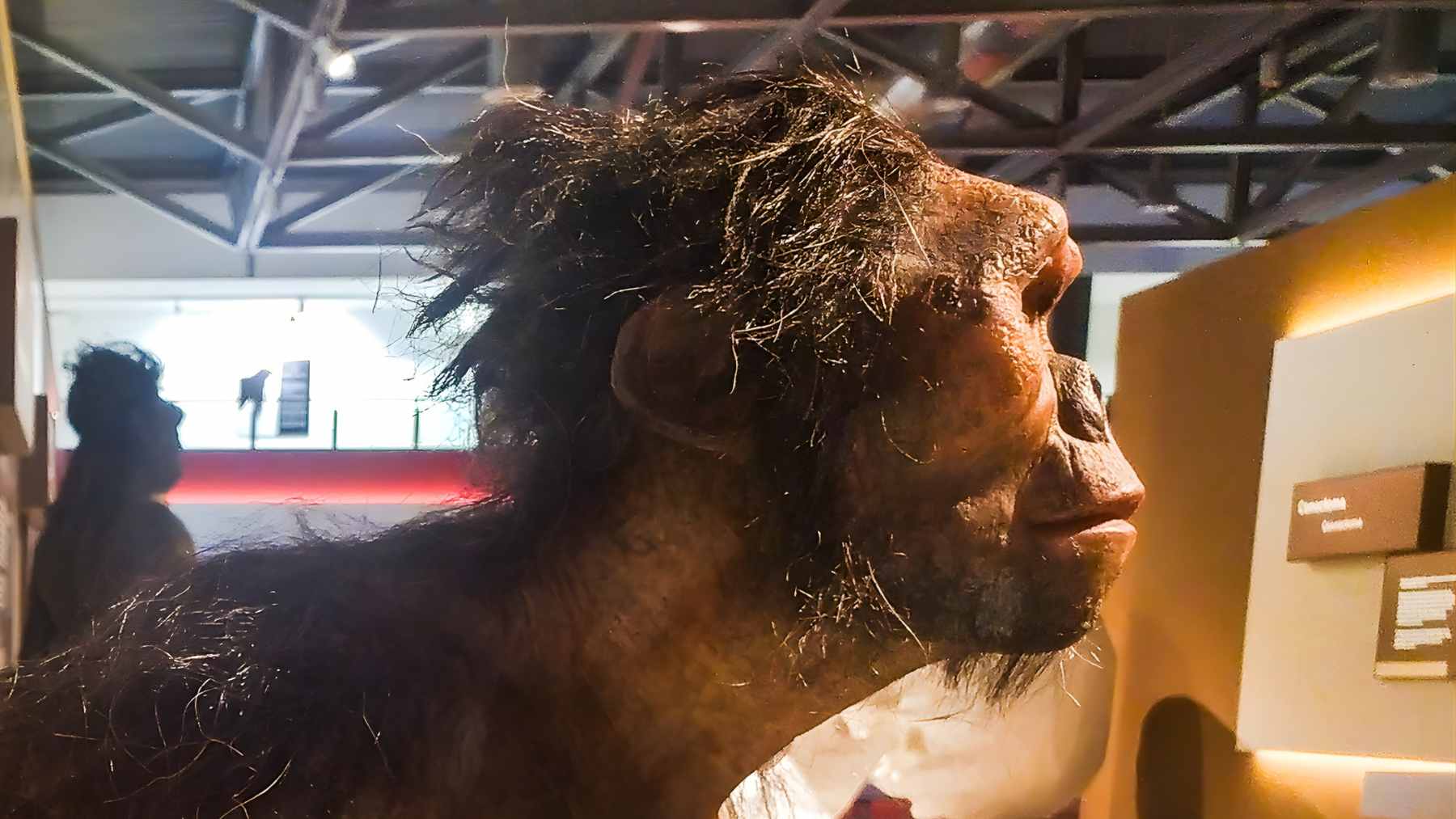
Did the Neanderthals disappear from the earth, or are they still moving through our cells every day? A new statistical study suggests that our closest extinct cousins didn’t just die. Instead, they may have gradually mixed with the growing wave of Homo sapiens, leaving behind only a few genes.
For anyone who has ever taken a home DNA test and seen a small percentage of Neanderthal ancestry, this picture sounds incredibly human. That small number may not be the only party fact. It may be the last trend of a lifetime that disappeared rather than being destroyed overnight.
The silent disappearance documented in mathematics and genetics
The new work, led by Andrea Amadei and his colleagues, builds a simple but powerful model for analysis. Instead of thinking about extreme climatic shocks or violent conflicts, the researchers ask what happens when small Neanderthal groups repeatedly host a few people from the large population of Homo sapiens over thousands of years.
In their example, Neanderthal communities are small and scattered throughout Eurasia. Modern people are very numerous and constantly sending people to migrate to those groups. Each arrival brings new genes into the mix.
If the process is repeated over and over again, the calculations show that the Neanderthal genetic diversity could be completely diluted within ten to thirty thousand years, even if no species has a chance to survive.
Practically, the model suggests that only a few modern humans entering the Neanderthal lineage after a few decades would be enough to change the genetic balance during evolution. No need for an apocalypse. Just slow, persistent mixing.
The combination is consistent with what we see in modern DNA
This gradual absorption fits well with what geneticists have been discovering over the past decade. People with out-of-Africa ancestry usually have 1% to 2% Neanderthal DNA, which is a similar trait to most Eurasians.
Those remains are difficult to explain in one brief mating episode. Rather, they are consistent with a scenario in which Neanderthals and modern humans intermingled repeatedly as Homo sapiens spread across Africa and across Europe and western Asia.
Other studies have shown gene flow between the two lineages 200,000 to 250,000 years ago, long before Neanderthals disappeared from the fossil record.
The new model reinforces that image. It shows that if reproduction continued for 10,000 to 30,000 years, the result would be the same as today. Most of the Neanderthal genome would have been gone, however a small fraction would still have spread to modern humans living far from Africa.
Rethinking what it really means
If this plan is correct, the Neanderthals didn’t disappear all at once. Their unique skull shapes, tools and rituals may have disappeared from the archaeological record, but their genes continued to travel among new host populations. In terms of species, this is more like a slow thaw than a curtain call.
That raises an uncomfortable but important question. When we say species are extinct, are we talking about bodies, cultures or DNA? In the case of the Neanderthals, their recognizable populations and lifestyles became extinct. Yet their lineage lives on in bits and pieces within us, whispering to our genes that our story was never ours.
The authors are careful to note that their model does not provide additional power. Climate change, vegetation change, disease, or direct competition for prey may all have pushed Neanderthal subpopulations into situations where it is possible for humans to mix and interbreed with modern humans.
The work shows that human pressure and gene flow alone can explain the genetic effect, but it does not mean that they are the only factors at play.
Why this is important for today’s biodiversity
At first glance, the debate about Neanderthals may seem far removed from current environmental problems, from shrinking forests to warming oceans. Yet the same fundamental process that would have erased Neanderthal genetic identity is occurring naturally now.
When a rare species meets more and more relatives, its genetic makeup can be diluted until there is nothing that distinguishes it.
The authors show that their method can be adapted to study hybridization in other animals and plants, including endangered species. It’s a reminder that extinction isn’t always loud. Sometimes it looks like a healthy body and a busy environment on the surface, while the unique genes disappear in the background.
At the end of the day, this research prompts us to see human evolution as a network of crossing and integration rather than a simple ladder. The line between “them” and “us” seems to be more blurred than the images in the textbooks suggest.
The lesson was published in Scientific Reports.
#Neanderthals #didnt #die #out…they #blended #invisible