Primordial black holes (PBHs) are a very special type of black hole, thought to have formed from dense pockets of subatomic matter in the seconds after the Big Bang – and a new study reports what may be the first direct time.
That may take years to prove, but the prospect is exciting.
Black holes are usually caused by the collapse of a supernova star, but scientists have long thought that PBHs could have existed in the early Universe, without the need for a star. It has long been a hypothesis, but there is a growing body of recent evidence that points to their existence.
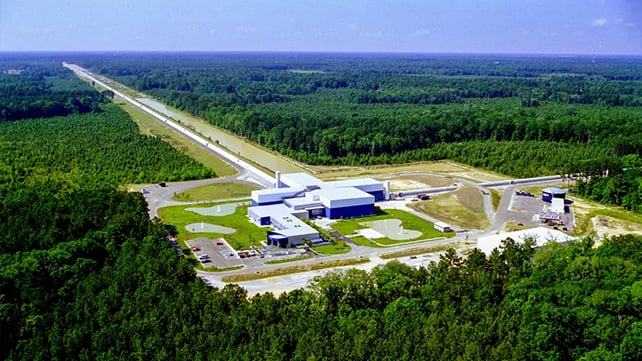
Now, astronomers Alberto Magaraggia and Nico Cappelluti, from the University of Miami, have observed another possible PBH using the Laser Interferometer Gravitational-Wave Observatory (LIGO), located in both Washington and Louisiana.
Gravitational waves that LIGO observes ripple through space, and can be produced by the collision of two black holes. A signal captured by LIGO and analyzed by researchers showed a collision where one of the objects was less than one solar mass (the mass of the Sun) – a possible PBH.
“The most common black holes appear as a result of a supernova, the death of a massive star,” says Cappelluti. “Therefore, their mass can range from several times the mass of the Sun to billions of solar masses.”
On the other hand, primordial black holes are expected to have much lower masses.
“We believe our study will help ensure that [PBHs] of course they are,” says Cappelluti.
Further study of the signal, known as S251112cm, is needed to know for sure, but the researchers say the presence of a PBH with a subsolar mass is the most likely explanation.
Magaraggia and Cappelluti also calculated the expected frequency of PBHs in space, and from there how often LIGO can expect to see them – which is consistent with data from LIGO since it first detected gravitational waves in 2015.
“We tried to estimate how many black holes there might be in the Universe and how many LIGO should detect,” says Magaraggia.
“And our results are encouraging. We predict that subsolar black holes like the ones LIGO might see should be rare, consistent with how often such events have been seen so far.”
Like normal, ordinary black holes, PBHs do not allow any light to escape, making them difficult to detect. They are also believed to be smaller than other black holes, possibly up to the size of an asteroid in some cases.
Add in the difficulties of looking back billions of years of time, and we’re talking about seeing needles in a cosmic haystack. However, if they can be identified and mapped, they could help explain another phenomenon in the universe: dark matter.

Like PBHs, dark matter is also a hypothesis, but astronomers think it may make up 85 percent of the mass of the Universe, and will be responsible for holding everything else together. Although we cannot see dark matter directly, clues to its existence can be found in the behavior of space and time around us.
PBHs may account for most of dark matter, experts think. There would have been an incredibly high number to begin with, starting with a very small size, and then it would have expanded to fill most of the space.
We’ll need to see more PBHs to confirm their existence, but that should become more common as systems like LIGO continue to be developed and new instruments come online – such as the European Space Agency’s Interferometer Space Antenna (LISA), a gravitational wave detector due to launch in 2035.
Related: Gaia Detects Black Swarm of Black Holes Moving Through Milky Way
“LIGO has picked up very strong evidence that these types of black holes exist, but we’ll need to see another signal or a few more to get the smoking gun confirmation that they’re real,” says Cappelluti.
“What is clear is that they cannot be dismissed as genuine.”
The research will be published in an upcoming issue of The Astrophysical Journaland is available on arXiv.
#LIGO #discovered #black #hole #scientists