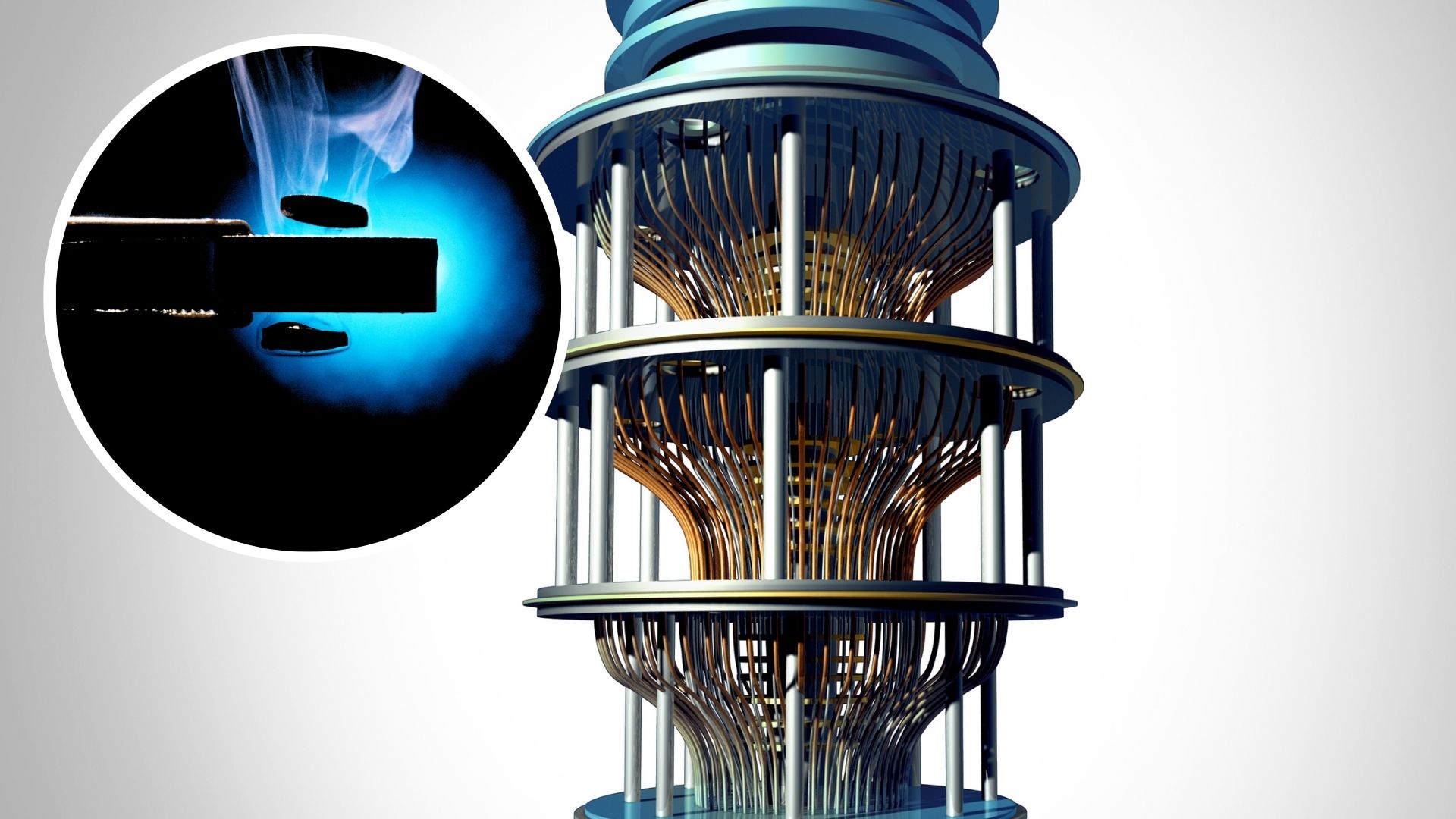
Researchers in the United States have revealed the secrets of superconductors with high temperatures.
Researchers at the US Department of Energy (DOE) Argonne National Laboratory have discovered how small changes in the structure of superhydride enable high temperatures close to room temperature but extreme pressure – providing clues to designing more efficient superconductors.
“These experiments show what the improved APS can do. We can now study atomic-level structures in unprecedented detail in materials under extreme pressure,” said Maddury Somamazulu, an Argonne physicist.
Superconductors allow electricity to flow without resistance
Researchers have revealed that superconductors allow electricity to flow without resistance, meaning no energy is lost to heat. This property makes them useful for technologies such as MRI scanners, particle accelerators, magnetic-levitation trains and other electrical transmission devices.
They also point out that most superconductors, however, only work at very low temperatures – usually hundreds of degrees below zero Fahrenheit. Keeping the material cold requires complex and expensive cooling methods, which limits where superconductors can be used.
Now, US researchers have helped take a step towards reducing that limit. They have gained new insight into a class of materials called superhydrides that can become superconducting at very high temperatures – about 10 degrees Fahrenheit.
In the new study, Hemley and his co-researchers examined whether changing the chemistry of the material could reduce the pressure required for superconductivity. They added a little yttrium to the lanthanum superhydride to make it more stable and reduce the pressure required.
“To achieve these extreme pressures, we squeezed a small sample between two diamonds,” said Maddury Somamazulu, an APS physicist. A diamond-anvil-class tool can produce pressures in excess of five million atmospheres.
Making superconducting materials at high pressure and temperature
After creating a superconducting material at high pressure and temperature, the team used high-energy X-rays from APS to study its structure (at beamlines 16-ID-B and 13-ID-D).
Vitali Prakapenka, a light scientist and research professor at the University of Chicago, said: “We directed intense X-ray light at a sample only a few micrometers thick and about ten to twenty micrometers wide.” One micrometer is about 1/70th the width of a human hair.
A recent development of the APS made these measurements possible. The brighter, more tightly focused X-ray beam allowed researchers to study much smaller samples while changing the pressure, according to a press release. .
“That block allowed us to isolate the signals from the small sample rather than from the material around the diamond anvils,” said Prakapenka.
The team found that small differences in how the atoms are arranged in the crystal lattice can greatly affect superconductivity. They chose two different crystal structures, each of which becomes superconducting at slightly different temperatures, according to the release.
“These tests show what the improved APS can do,” Somamazulu said. “We can now study atomic-level structures in unprecedented detail in materials under high pressure.”
The researchers also emphasize that although the pressures used in the experiments are still very high – about 1.4 million times atmospheric pressure – the researchers see this as part of the long way forward. They add other factors to reduce the pressure more with the aim of making these devices work.
#scientists #reveal #secrets #high #temperature #superconductors